FRANCISCA CARVALHO
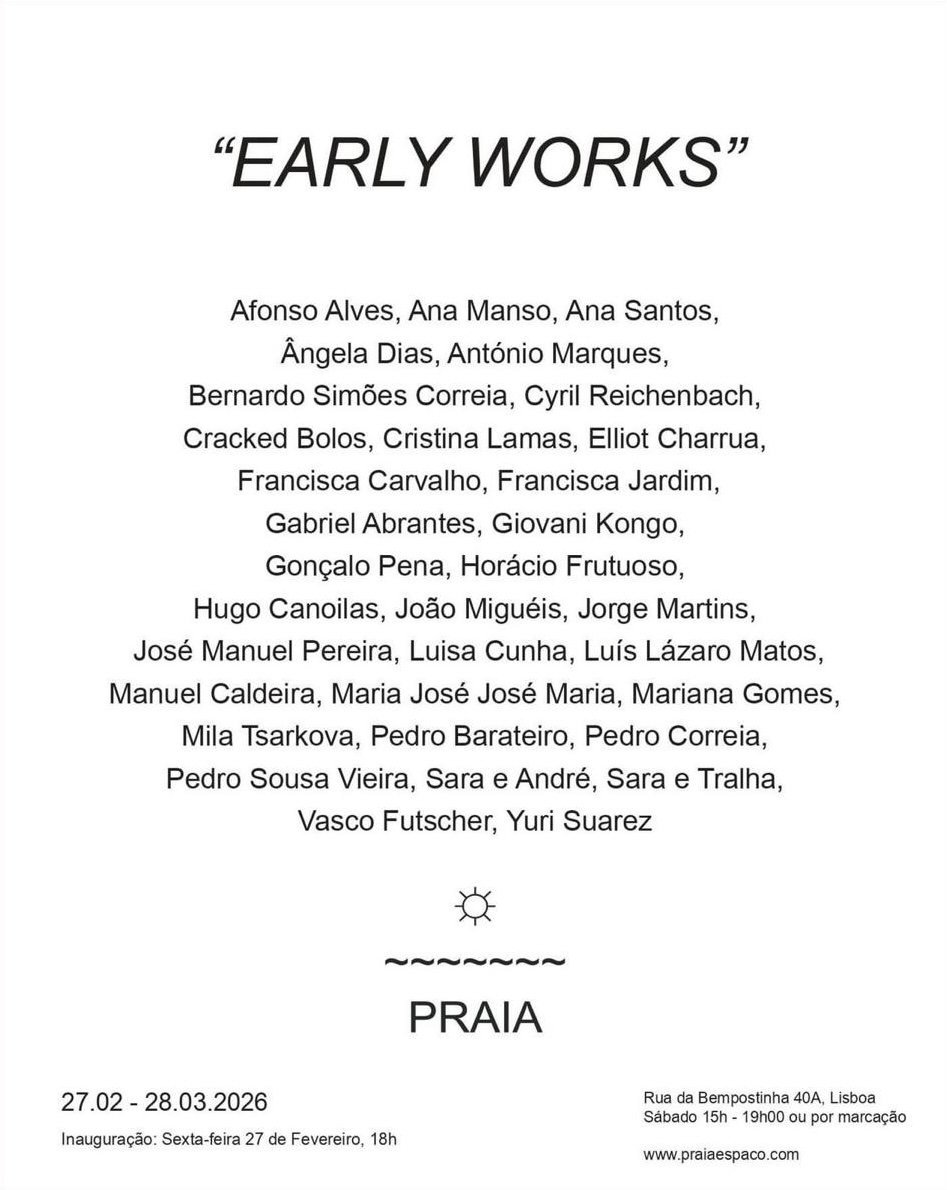
Early Works
Inauguração | Opening
27.02 18h
Até | Until 28.03.2026
Exposição colectiva | Group exhibition
The Beginning of Everything
In his epic poem – widely disseminated, distributed, read, reread, and profoundly studied, considered foundational in the construction of Western thought and culture as we know it – Ovid, when philosophically reflecting on reality, impermanence, and the inevitability of change and transformation, states, "what we were, or are now, we will not be tomorrow."
This idea of impermanence and constant mutation, which allows us to understand ourselves and others (in their various instances) as transient beings, brings us closer to the possibility of understanding life and its circumstances as inscribed in a model of permanent becoming, assuming an idea of movement as an agent of this transformative process. In the same work, Ovid explores the idea of original formation, of universe creation, from a cosmological perspective, based on two possible narratives: on the one hand, Chaos – endowed with an ancient and obscure force that operates through violent disjunction and separation – and on the other, Eros – endowed with a powerful force of attraction that operates through approximation and union (both already present in the poetry of Hesiod, a reference for Ovid). In the field of visuality and the symbolic construction of representations, the two deities were conceived as unrepresentable. Catabolic or harmonious, destructive or constructive, profoundly violent or appeasing, the power of their actions, their movements, and their initiatives was understood as a formless force, or perhaps, as a form in permanent mutation. Their presences were signaled by their actions and their generative, creative energy, and the result of their moves, only that, was conceivable through material formulations, capable of representation. It is curious to think that, in this context of philosophical reflection (which is so fundamental to us), the author was already, precisely, trying to name and contain (through the use of language and by means of a poetic narrative) a possibility of representation. To name is to represent. To name is to propose a form in its potential. The exhibition “Early Works”, which inaugurates the new PRAIA project – by artists Alexandre Camarão and Bernardo Bello – proposes itself as an encounter between visual works understood as signals of generative movements or originating moments. Drawing a broad temporal arc (from the beginning of the 1960s to the present), the exhibition was conceived as a set of constellations that propose relationships – sometimes tense and vigorous, other times dialogical and pacifying – between sets of works indicated by the thirty-two artists participating in the exhibition. The only criterion suggested by the pair responsible for the project relates to the possibility of them being early career works, that is, works recognized by the authors themselves as nameable within that category (which naturally goes beyond the temporal question of their dating). The groups, or constellations (to maintain the cosmological framework) that result from a careful, attentive and profoundly intuitive assembly, point to this territory of formulations in becoming. They allow the revelation of scrutinizing, investigative and laboratory processes, of records driven by the generative impulse, by the search for the fixation of imagined visions and by the establishment of a gaze that allows us to recognize them as forms in potential. In this territory – and similar to the morphological dimension of the beach as a (always impermanent) meeting place of particles with distinct origins in a state of suspension – the proposal focuses on allowing movement, displacement, and the possibility of attraction between the various suspended particles. For the participating artists – from quite different generations – the challenge is unequivocal: to allow (with enormous freedom and detachment) the integration of their work into a new, unpredictable, and broadly exploratory context, allowing themselves to assume a commitment to reinventing their own freedoms, in a context of social and cultural organization that is intended to be alive and in permanent transformation. To let themselves be penetrated by the forces of attraction and disjunction, by the apparent invisibility of connections, or by forms that are still formless. To name, to point, to signal. To build layers and help to construct a new possible design for this beginning of everything.
Ana Anacleto
February 2026