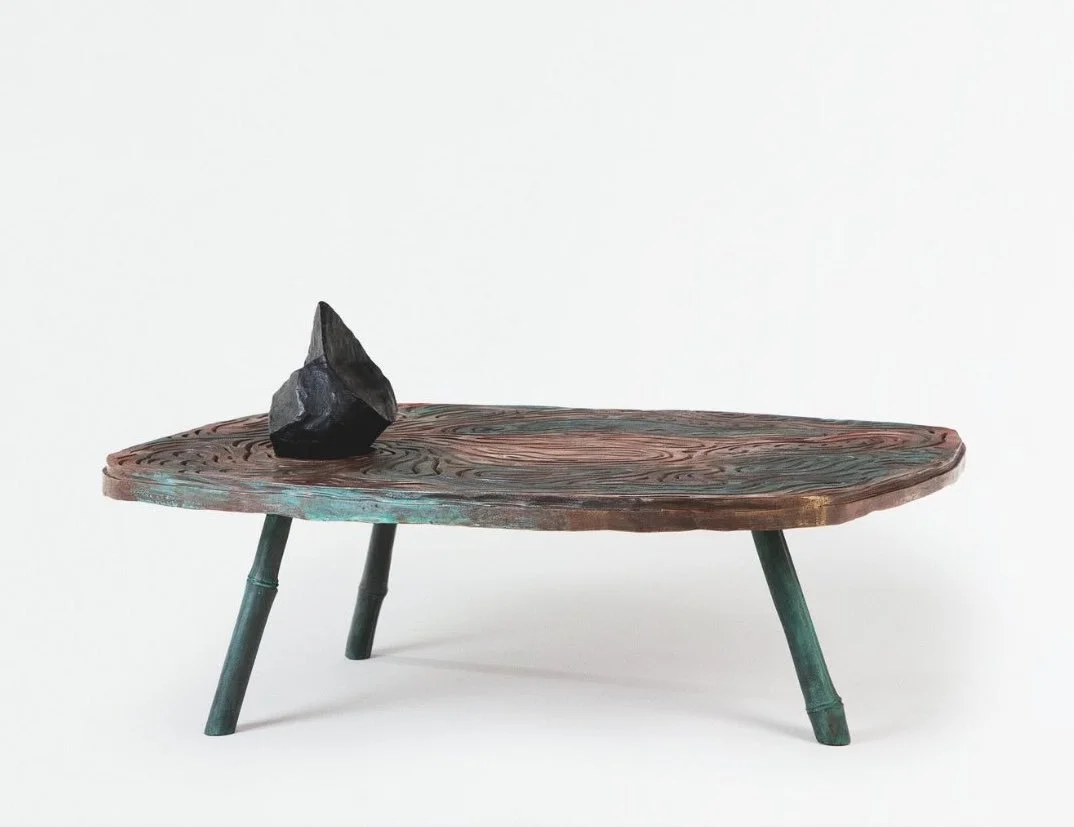
Éden, 2025, bronze (natural, pátina preta ou pátina colorida)
TIAGO MESTRE
Atoriê
> 23.01
Exposição colectiva | Group exhibition
Projeto | Project by Camila Tariki
Tiago Mestre (Beja, Portugal, 1978) apresenta para a ATORIĒ uma mesa que opera no limiar entre escultura e mobiliário, onde a funcionalidade é continuamente tensionada por desvios formais e narrativos.
Fundida em bronze e recoberta por camadas de pátina aplicadas como pintura, a peça condensa o interesse do artista pelos processos técnicos como linguagem estética: o fogo, o molde e a matéria como operadores de forma e pensamento. A superfície do tampo, atravessada por vincos sinuosos e variações de luz e sombra, oscila entre a lâmina d’água de uma lagoa e uma topografia lunar, entre o fluido e o geológico.
Os pés, fundidos a partir de bambus reais, preservam no metal a memória do vegetal que serviu de matriz, aproximando o vernacular e o artesanal da técnica moderna sem hierarquia entre eles.
Entre escultura e arquitetura, Mestre propõe um objeto que se comporta como estrutura e imagem ao mesmo tempo, afirmando o gesto escultórico como princípio de uso e a funcionalidade como construção poética.
//
Tiago Mestre (Beja, Portugal, 1978) presents for ATORIĒ a table that operates on the threshold between sculpture and furniture, where functionality is continuously challenged by formal and narrative deviations.
Cast in bronze and covered with layers of patina applied like paint, the piece condenses the artist’s interest in technical processes as an aesthetic language: fire, mould, and matter as agents of form and thought. The tabletop surface, marked by sinuous folds and variations of light and shadow, oscillates between the water sheet of a lagoon and a lunar topography, between the fluid and the geological.
The legs, cast from actual bamboo stalks, preserve in metal the memory of the plant that served as its matrix, bringing the vernacular and the artisanal closer to modern technique without establishing a hierarchy between them.
Between sculpture and architecture, Mestre proposes an object that behaves as structure and image at once, asserting the sculptural gesture as a principle of use and functionality as a poetic construction.